> For the complete documentation index, see [llms.txt](https://docs.dbnl.com/llms.txt). Markdown versions of documentation pages are available by appending `.md` to page URLs; this page is available as [Markdown](https://docs.dbnl.com/v0.23.x/using-distributional/metrics.md).
# Metrics
## What are Metrics?
Metrics are measurable properties that help quantify specific characteristics of your data. Metrics can be user-defined, by providing a numeric column computed from your source data alongside your application data.
Alternatively, the Distributional SDK offers a comprehensive set of metrics for evaluating various aspects of text and LLM outputs. Using Distributional's methods for computing metrics will enable better data-exploration and application stability monitoring capabilities.
The [SDK documentation](/v0.23.x/reference/python-sdk/eval-module/quick-start.md) contains more details on Metrics including some example usage.
### Using Metrics
The SDK provides convenient functions for computing metrics from your data and reporting the results to Distributional:
```python
import dbnl
import dbnl.eval
import pandas as pd
# login to dbnl
dbnl.login()
project = dbnl.create_project(name="Metrics Project")
df = pd.DataFrame(
{
"id": [1, 2, 3],
"question": [
"What is the meaning of life?",
"What is the airspeed velocity of an unladen swallow?",
"What is the capital of Assyria?",
],
"answer": [
"To be happy and fulfilled.",
"It's a question of aerodynamics.",
"Nineveh was the capital of Assyria.",
],
"expected_answer": [
"42",
"It's a question of aerodynamics.",
"Nineveh was the capital of Assyria.",
],
}
)
# Create individual metrics
metrics = [
dbnl.eval.metrics.token_count("question"),
dbnl.eval.metrics.word_count("question"),
dbnl.eval.metrics.rouge1("answer", "expected_answer"),
]
# Compute metrics and report results to Distributional
run = dbnl.eval.report_run_with_results(
project=project, column_data=df, metrics=metrics
)
```
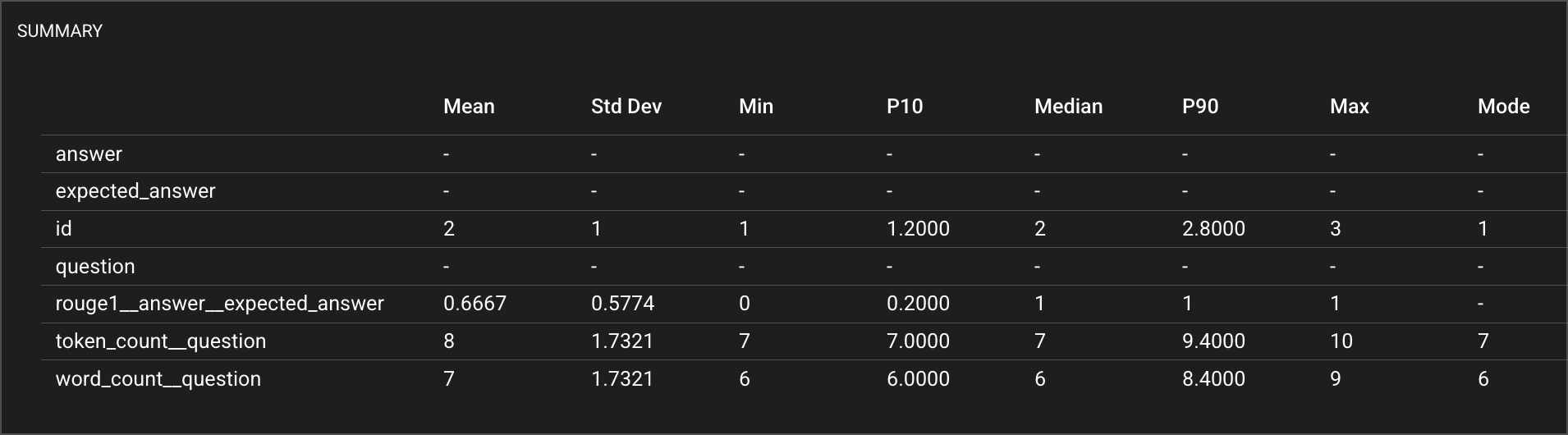
Summary statistics for the Run uploaded above
See the [SDK documentation](/v0.23.x/reference/python-sdk.md) for a more complete list and description of available metrics.
### Convenience Functions
The SDK includes helper functions for creating common groups of related metrics based on consistent inputs.
```python
import dbnl
import dbnl.eval
import pandas as pd
# login to DBNL
dbnl.login()
project = dbnl.create_project(name="Metrics Project")
df = pd.DataFrame(
{
"id": [1, 2, 3],
"question": [
"What is the meaning of life?",
"What is the airspeed velocity of an unladen swallow?",
"What is the capital of Assyria?",
],
"answer": [
"To be happy and fulfilled.",
"It's a question of aerodynamics.",
"Nineveh was the capital of Assyria.",
],
"expected_answer": [
"42",
"It's a question of aerodynamics.",
"Nineveh was the capital of Assyria.",
],
}
)
# Get standard text evaluation metrics
text_eval_metrics = dbnl.eval.metrics.text_metrics(
prediction="answer", target="expected_answer"
)
# Get comprehensive QA evaluation metrics
qa_metrics = dbnl.eval.metrics.question_and_answer_metrics(
prediction="answer",
target="expected_answer",
input="question",
)
# Compute metrics and report results to Distributional
run = dbnl.eval.report_run_with_results(
project=project, column_data=df, metrics=(text_eval_metrics + qa_metrics)
)
```
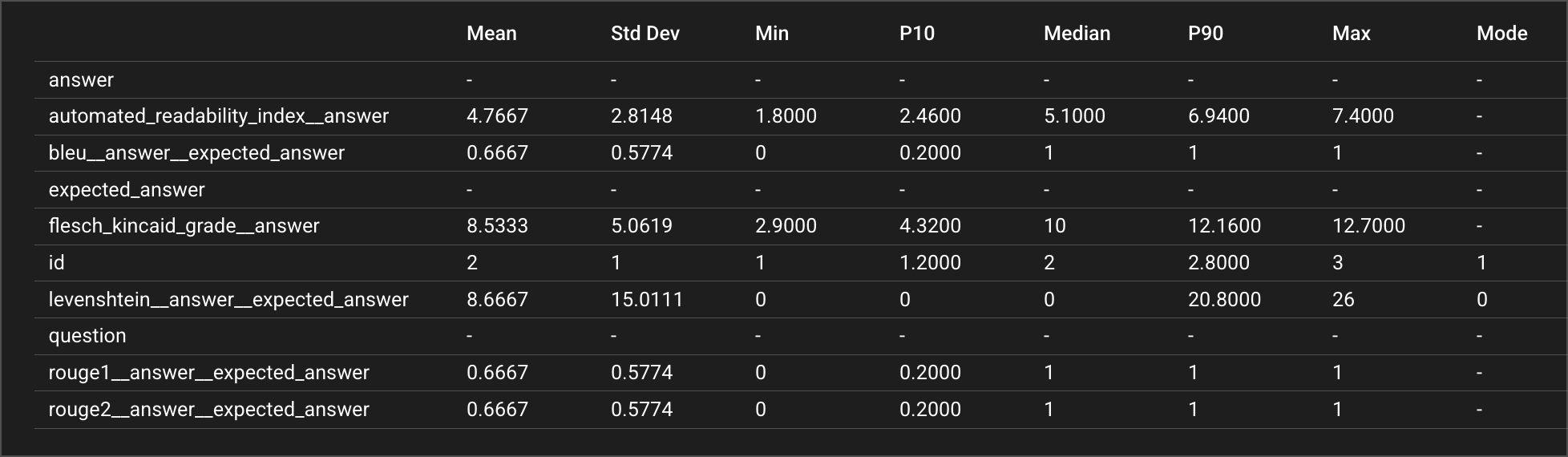
Summary statistics for the Run uploaded above
See the [SDK documentation](/v0.23.x/reference/python-sdk.md) for a more complete list and description of available functions.